
Prolonged exposure to freezing temperatures can cause health problems.
Cold environments challenge the worker in three ways: air temperature, wind speed, and humidity, or wetness. Humid conditions in cold weather conduct heat away from the body 25 times faster than dry air. In order to work safely, these challenges have to be counterbalanced by proper insulation in the form of layered protective clothing, by physical activity, and by controlled exposure to cold (work/rest schedule).
Working outdoors for long periods of time elevates your risk for cold-related illness, which can include frost nip, frostbite, and hypothermia. Certain activities can also elevate your risk, like working on or near water or working at night.
The video below summarizes the symptoms of frostbite and hypothermia:
https://youtu.be/-TlWJIWrcwg
Frostbite
Frostbite can occur when any part of the body freezes. Ice crystals form within or between the cells. Red blood cells and platelets clump and restrict blood flow, especially to extremities like the ears, fingers, toes, and nose.
These areas usually are the first to turn cold, white, hard, and numb. Frostbite can be deceptive because it causes numbness, rather than pain. People may not know it is happening in time to prevent serious damage.
Frostbite occurs when body tissue freezes, such as your fingers, toes, ear lobes or the tip of your nose. In order to protect vital organs, your body cuts circulation to your extremities, including your feet, hands and nose, which eventually freeze.
In order to avoid frostbite, the best thing to do is stay inside when it is bitterly cold. If you have to be outside, you should cover every part of your body, including your ears, nose, toes and fingers. You also want to keep your skin dry and stay out of the wind as much as possible.
Be sure to stay hydrated by drinking plenty of fluids, since hydration increases your blood’s volume, which can help prevent frostbite. However, you should avoid caffeine and alcohol. Caffeine constricts your blood vessels, which will prevent warming of your extremities. Alcohol reduces shivering, which your body does to help keep you warm.
First Aid for Frostbite
To treat frostbite, the victim should get out of the cold and remove any wet clothing. If shelter is not available, try to protect skin from additional exposure. Affected body parts should be warmed gradually in warm, but NOT HOT, water. Temperature of the water should be between about 104 and 108° Fahrenheit. Wrap or cover other areas with warm blankets, if possible. Thawing occurs when the affected area begins to turn pink or red. If it remains white, that means more time must be allowed for thawing in warm water.
If the victim runs the risk of thawed areas freezing again because they may need to be relocated, wait to thaw. Always seek medical attention for frostbite.
- Get out of the cold, remove wet clothing.
- Protect skin from further exposure
- Gradually warm frostbitten areas.
- Place feet or hands in warm water – 104-108°F
- Wrap/cover other areas with warm blankets
- If the areas might freeze again, do not thaw them.
- Seek medical attention.
- Never use direct heat or rubbing to warm affected areas.
- Don’t walk on affected feet or toes if possible.
Hypothermia
If you or someone you’re working with is demonstrating signs of hypothermia, you may have to help them or yourself before emergency responders arrive.
- First, call 911 for emergency medical assistance.
- Monitor the victim’s breathing until help arrives. If their breathing stops or seems dangerously slow or shallow, begin administering CPR.
- If possible, move the victim out of the cold. If moving indoors is not possible, protect them from the wind, cover their head, and insulate them from the cold ground.
- Remove any wet clothing.
- Never apply direct heat, but you can apply warm compresses to the body’s core.
- Don’t administer alcohol and don’t massage or rub the person. If they have hypothermia, they may also have frostbite. Rubbing frostbitten tissue can result in severe damage.
Preventing Cold-Related Illness or Injury
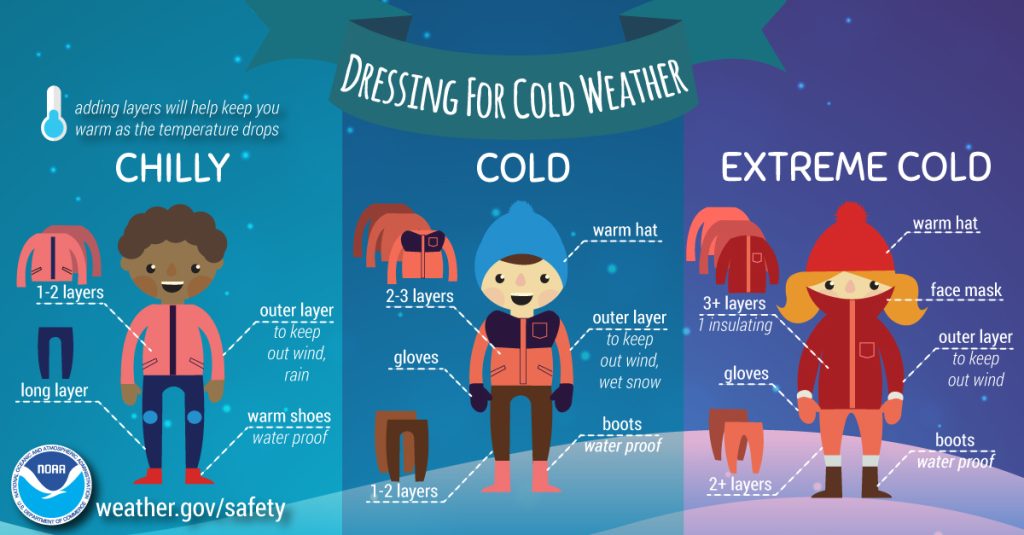
Your best protection against cold-weather illness is wearing appropriate clothing for the weather conditions and your expected activities. The goal in choosing what you wear is to regulate the amount of heat and perspiration you generate while working. If you’re wearing too many items of clothing or the work pace is too fast, excessive sweating may occur. The clothing next to your body will become wet and the insulation value of the clothing will decrease dramatically, increasing your risk for cold injuries.
Clothing should be worn in multiple layers, which provide better protection than a single, thick garment. The air between layers of clothing provides better insulation than the clothing itself. Having several layers also gives you the option to open or remove a layer to better regulate our body temperature as the temperature and your activities change. Your innermost layer should be able to wick moisture away from the skin to keep it dry. Thermal underwear made from polyesters or polypropylene is most suited for this purpose.
For work in wet conditions, the outer layer of clothing should be waterproof.
If the work area cannot be shielded against wind, an easily removable windbreak garment should be used.
Under extremely cold conditions, heated protective clothing should be made available if the work cannot be done on a warmer day.
Wear a hat suitable for the conditions, including being able to keep the ears warm. If a hard hat is required, a knit cap or a liner under a hard hat can reduce excessive heat loss. Consult with the hard hat supplier or manufacturer for appropriate liners that do not compromise the protection provided by the hard hat.
Clothing should be kept clean since dirt fills air cells in fibres of clothing and destroys its insulating ability.
Clothing must be dry. Moisture should be kept off clothes by removing snow before entering heated shelters. While the worker is resting in a heated area, perspiration should be allowed to escape by opening the neck, waist, sleeves and ankle fasteners or by removing outerwear. If the rest area is warm enough it is preferable to take off the outer layer(s) so that the perspiration can evaporate from the clothing.
If fine manual dexterity is not required, gloves should be used below 4°C for light work and below -7°C for moderate work. For work below -17°C, mittens should be used.
Cotton is not recommended. It tends to get damp or wet quickly, and loses its insulating properties. Wool and synthetic fibres, on the other hand, do retain heat when wet.
It is also important to pay attention to protection of your feet when working outdoors in cold weather. Wear footwear that is appropriate for your activities. You may prefer to wear one pair of thick, bulky socks or two pairs – one inner sock of silk, nylon, or thin wool and a slightly larger, thick outer sock. Liner socks made from polypropylene will help keep feet dry and warmer by wicking sweat away from the skin. However, as the outer sock becomes damper, its insulation properties decrease. If work conditions permit, have extra socks available so you can dry your feet and change socks during the day.
Always wear the right thickness of socks for your boots. If they are too thick, the boots will be “tight,” and the socks will lose much of their insulating properties when they are compressed inside the boot. The foot would also be “squeezed” which would slow the blood flow to the feet and increase the risk for cold injuries. If the socks are too thin, the boots will fit loosely and may lead to blisters.
In extremely cold conditions, where face protection you also may need to protect your face and eyes.
Be sure to drink fluids often especially when doing strenuous work.