
Quick Safety Links
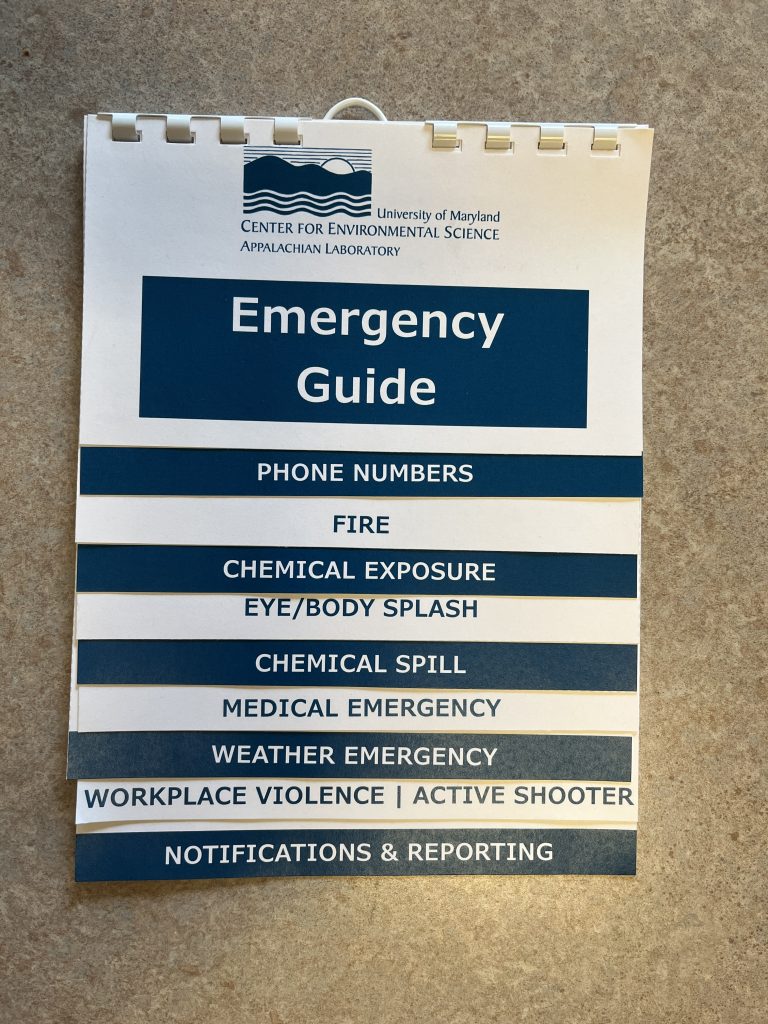
It’s very important to know how to respond to an emergency before it happens. That is why emergency response is included in our Introductory Safety Training for all users of our facility. You can also reference the Emergency Guides that are posted in common areas, in all labs, near each indoor Emergency Blue Light unit, and at all of our exits. They include important phone numbers along with steps to take in most commonly expected emergencies
If you would like a copy of one for your work area, please contact Katie Kline at kkline@umces.edu.
Emergency Response Procedures
You can also reference common emergency response procedures below:
| FSU Campus Police, Emergency | 301-687-4222 |
| Fire, Ambulance, Law Enforcement | 9-1-1 |
| FSU Campus Police, Non-Emergency | 301-687-4223 |
| Katie Kline, Lab Manager | 301-697-1600 (cell) 301-689-7122 (office) |
| Heather Johnson, Associate Director | 301-268-4483 (cell) 301-689-7111 (office) |
| John Piasecki, Facilities Manager | 301-707-1355 (cell) |
| Poison Control Hotline | 800-222-1222 |
| MDE Emergency Response Program | 866-633-4686 |
- Rescue/Remove person(s) from the scene/room.
- Alert/Activate the nearest fire pull station, alert colleagues in nearby vicinity, and call 911.
- Confine fire/smoke by closing doors and windows.
- Extinguish/Evacuate: If you have been trained in the use of a fire extinguisher, fight a small fire if it is safe to do so or to escape a large fire. Evacuate facility via the closest, safest exit.
- Report to Rally Point at flagpole.
- Do NOT use elevators.
- Those needing assistance should be evacuated to the nearest stairwell. Immediately notify emergency responders.
Chemical Inhalation:
- Close containers and evacuate immediate area to fresh air.
- If symptoms, such as headaches, nose or throat irritation, dizziness, or drowsiness persist, seek immediate medical attention. Be prepared to provide name and SDS of chemicals that were involved.
- Review the SDS to determine signs and symptoms of overexposure. If signs or symptoms are present, immediately seek medical evaluation.
Chemical Ingestion:
- Dial 911 immediately.
- Call Maryland Poison Control Center for interim advice: 800-222-1222.
- Never induce vomiting unless directed to do so by a health care provider.
- Be prepared to provide name and SDS of chemical(s) that were involved.
- Immediately rinse eye and inner surface of eyelid with water continuously for 15 minutes.
- Forcibly hold eye open and rotate eyeballs to ensure effective wash behind eyelids.
- Remove contact lenses while rinsing. Do not reinsert contact lenses.
- Seek medical attention regardless of the severity. Be prepared to provide name and SDS of chemicals that were involved.
- Flood exposed area with running water from faucet or safety shower for at least 15 minutes.
- While rinsing, remove contaminated clothing immediately. Avoid contact with eyes. Ensure that chemical has not accumulated in shoes or under jewelry.
- Place clothing in plastic bag and seal.
- Seek medical attention. Be prepared to provide name and SDS of chemicals that were involved.
Minor Spill:
- Alert people in immediate area of spill.
- Don appropriate protective equipment, including splash goggles, appropriate gloves, and lab coat.
- Avoid breathing vapors from spill and confine spill to small area. Use appropriate spill kit or absorbents to collect the spilled material.
- Bag cleanup material and label with a Waste Chemical Label.
- Clean spill area with water.
- Contact Lab Manager for advice as needed.
Major Spill:
- Alert people in immediate area and isolate the area by closing doors.
- Contain the spill if safe to do so.
- If a fire or explosion hazard is present, do NOT unplug or turn electrical equipment on or off.
- Notify Lab Manager.
- Evacuate any nearby rooms that may be affected. If the hazard will affect the entire building, evacuate the entire building by pulling the fire alarm.
- Be prepared to provide emergency responders with information about the spill.
In the event of any injury or illness where assistance is needed:
- Contact emergency responders by dialing 911 or FSU Campus Police at: 301-687-4222.
- Retrieve the AED from the second floor lobby bridge.
- Turn on AED and follow the instructions.
First Aid Cabinets to treat minor injuries are located on the second and third floor lab wings and on the first floor lobby immediate outside the men’s bathroom.
Severe Weather Watch:
A WATCH means that conditions are favorable for severe weather, like a tornado. When a watch has been issued, be on alert for escalation to a warning.
Severe Weather Warning:
A WARNING means that severe weather is upon us. If possible, notification will be made via email and Omnilert text messages.
- Do not exit the building.
- Move to the first floor classroom to the rear of the room.
- Stay away from windows.
- Remain in place until the danger has passed.
Follow S.A.F.E.
- Secure your area.
- Alert by calling 911 OR 301-689-4222.
- Follow directions of emergency responders.
- Exit when directed.
Active Shooter—Run, Hide, Fight:
- Run: Escape if possible.
- Hide: Find location out of sigh, lock door, barricade entrance, silence phones/pagers.
- Fight (last resort): Act aggressively, do not hesitate.
In order to keep yourself and others safe, always remember the following: SEE SOMETHING…SAY SOMETHING