Appalachian Lab
Monthly Newsletter

As an environmentally-focused research and education institution, I hope that you agree that AL has a particular obligation to lead by example in environmental sustainability. We’ve made much progress in that regard over the last decade and there’s no reason to slow down. Here are three ways for you to get involved:

  • Our most recent achievement was the installation of a 150 kW solar array on AL’s roof. Please plan to join the AL community and various local, state, and federal dignitaries in the AL lobby at 2pm on April 23rd for a ribbon cutting event and reception to celebrate this occasion. E-invitations are forthcoming.
  • AL recently established a sustainability committee to help develop and advance sustainable practices and initiatives at the lab. If you have ideas or initiatives that you’d like considered, please talk with any committee member (Heather Johnson, Xin Chen, Cat Davis, Eric Farris, Burch Fisher, Nicole Ibrahim, Katie Kline, Cami Martin, and John Piasecki).
  • As part of the “100 for UMCES” Centennial celebration AL will collaborate with the C&O Canal Association to conduct a trash clean up along the canal on Saturday, May 31, from 9am-12pm. We’re aiming for 100+ total volunteer hours, which means we need at least 33.3 people to participate. Please sign up to express interest in participating. More details are forthcoming.


Thanks!

Dave

New Faces

Jillian Sturtevant, NICCEE Assistant

Jillian is working with Xin Zhang. Her research will consist of learning the GCAM model to a level of proficiency that allows scenario design and customization for addressing research questions pertaining to green ammonia production and use.  Jillian will also assist with coordination of modeling efforts across the Global Nitrogen Innovation Center for Clean Energy and the Environment (NICCEE) Information Hub, contribute to a study on the food security impacts of green ammonia deployment, and begin compiling nitrogen flow data for GCAM.  Her hobbies are baking, board games, and taking long walks.

Swati Suman, Assistant Research Scientist

Swati will be working as Assistant Research Scientist on Integrating Remote Sensing and Modelling techniques for Wildfire Risk with Mark Cochrane.  She loves to read. In her free time, Swati gardens, cooks, and like to learn new skills.

Photo of Swati Suman

Recent Achievements/Activities/Successes

Welcome Back, Nicole!

Nicole Ibrahim recently returned from her 6-month Boren Fellowship in Kazakhstan.  Click to read a recently published article about her experience at the Institute of Zoology.   In the photo below (courtesy of the Institute of Zoology), Nicole is shown working at the Chokpak ornithological station during the fall bird migration:
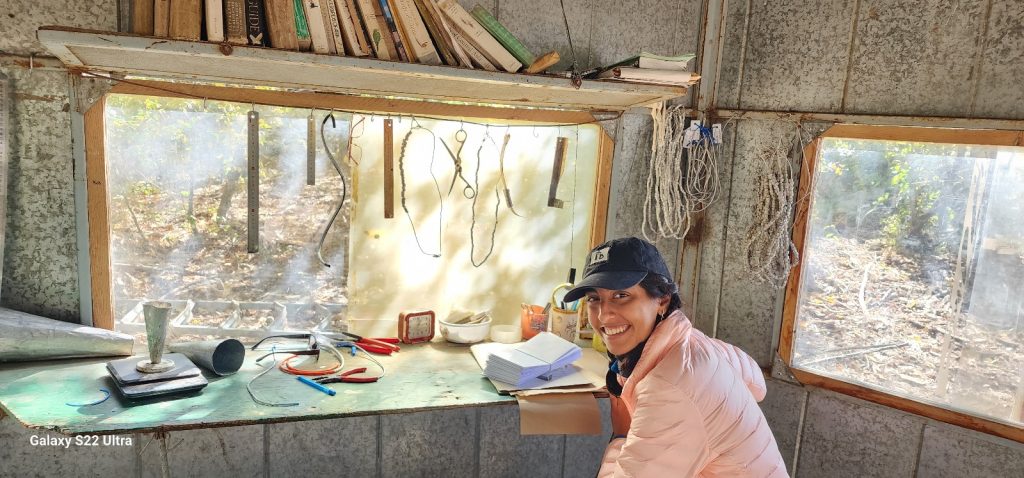
Photograph of Nicole working inside the Chokpak ornithological station during the fall bird migration.

Resurrecting Poplar Island Prescreening

The tentative date for a special UMCES pre-screening of the MPT film Resurrecting Poplar Island will be Wednesday, April 16 at the Annapolis Maritime Museum. The event will feature a panel discussion with UMCES scientists focused on the ecosystem restoration aspect of the project as well as relevant research displays and student posters. Contact Dave for more details.

The History of UMCES

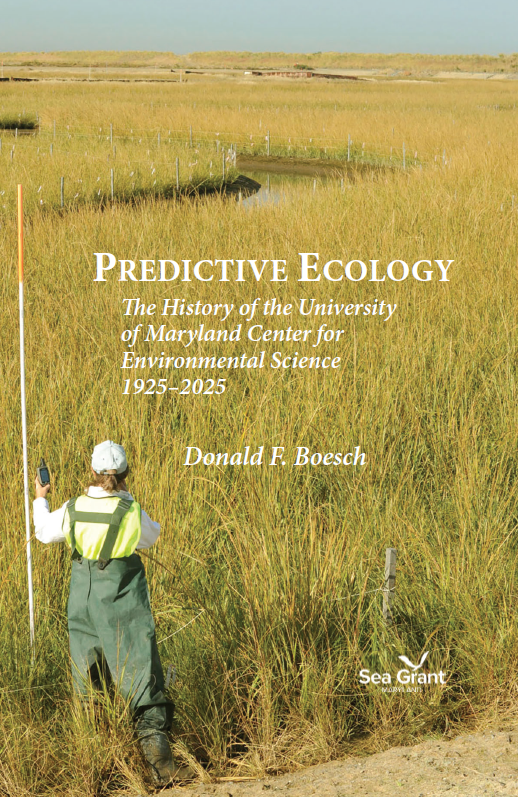
Don Boesch’s book, Predictive Ecology: The History of the University of Maryland Center for Environmental Science 1925-2025 has been published and is available for sale via the Maryland Sea Grant bookstore or at the in-person events (choose Pick Up during checkout). UMCES employees can use code UMCES100 for 30% off.


New Publications

Nemes, C.E., A.M. Lindsay, L.W. DeGroote, and E.B. Cohen. 2025. Close encounters: Behavioral responses of migrating songbirds to the perceived risk of predation. Behavioral Ecology.

Spotlight on Safety - Anatomy of a Chemical Label

When working with hazardous chemicals, clear and consistent labeling is essential for safety. The Globally Harmonized System of Classification and Labeling of Chemicals (GHS) ensures that chemical labels provide vital information to protect workers, emergency responders, and consumers. Let’s break down the six key components of a GHS-compliant chemical label like the one shown below and why each one matters.

Product Identifier

The product identifier names the chemical or mixture and may include details such as the Chemical Abstracts Service (CAS) number. This helps users identify the substance quickly and cross-reference it with safety data sheets (SDS).

Signal Word

A GHS label includes one of two signal words: “Danger” or “Warning.” “Danger” is used for more severe hazards, while “Warning” is for less serious risks. If no signal word appears, the chemical may not pose significant hazards under GHS criteria.

Pictograms

GHS labels use standardized pictograms to visually convey hazards. These symbols, enclosed in red diamond borders, warn about risks such as flammability, toxicity, or corrosiveness. The right pictogram ensures that even non-English speakers can recognize potential dangers.

Hazard Statements

Hazard statements describe the specific dangers associated with the chemical. Examples include “Causes severe skin burns and eye damage” or “May cause respiratory irritation.” These statements are assigned based on the chemical’s classification and ensure users understand the risks.

Precautionary Statements

Precautionary statements provide guidance on safe handling, storage, and emergency measures. They include instructions like “Wear protective gloves,” “Store in a well-ventilated place,” or “In case of fire, use a dry chemical extinguisher.” Following these precautions helps prevent accidents.

Supplier Information

The label must include the name, address, and phone number of the manufacturer or distributor. This ensures that users can contact the supplier for additional safety information or in case of an emergency.

GHS-compliant labels are more than just stickers—they are vital tools for workplace safety. Understanding each component helps workers handle hazardous chemicals responsibly and reduces the risk of accidents. Whether you’re an employer, employee, or safety professional, always check the label before using any chemical.

By staying informed and following proper procedures, we can all contribute to a safer work environment.

Here’s a quick GHS Label explainer video that we’ve developed to help review the parts of a GHS-compliant chemical label:

Admin Updates & Reminders

You can celebrate UMCES’ Centennial year with a unique email signature.  Visit our UMCES Intranet site for instructions.

Physical Inventory

UMCES has initiated the physical inventory process for fiscal year 2025.  Be aware that if you have a commuter item on inventory (this includes designated non-capital assets such as tablets, laptops, phones, etc. that are valued <$5K), Cami will be contacting you to have you either bring in the item for scanning/verification OR signing off on a commuter steward sheet (for larger items such as desktops/monitors/etc.).


Are you expecting a delivery or a visitor?

To better help the office staff, who all wear many hats and have to juggle a variety of tasks daily, we could use some help if you are expecting a delivery that needs special handling or a guest.

If you’re expecting a business delivery (samples, items you purchase on your own, etc.), please notify someone in the office (when feasible) so that we can keep an eye out for it and notify you when it arrives.

If you are hosting a visitor(s), send Heather an email with the visitor’s name, day/time of arrival and whether they will need the guest office so that it can be reserved.

With that information, we can also plan accordingly related to WiFi or other services and also ensure that it’s not a random visitor (salesperson, etc.) with whom you do NOT want to meet.

As a reminder, if a visitor arrives of whom we are not aware, they will be asked to wait in the vestibule until we reach the individual who they requested to see. If we can’t reach that individual when they arrive and we’re unaware of the visitor, we may ask them to leave. This is for safety and liability reasons.

Travel Planning Reminder

Effective immediately, any vehicle request that is related to a trip requiring a travel request must include the Concur travel request approval number in the comments section.

As a reminder, travel requests are required for the following trip types and are necessary for liability/worker’s comp coverage while an employee is on official UMCES travel:

1. Any travel that includes an overnight stay (in state or out of state)

and

2. Any out of state travel (even one day trips)

and

3. International travel


UMCES Intranet Training Sesssions

UMCES has scheduled training sessions on connecting to and navigating our intranet site hosted through SharePoint.  Each session will cover the same content.  You are welcome to attend any or all of the scheduled sessions:

Topic: SharePoint Training Session 1
Time: Mar 25, 2025 11:00 AM Eastern Time (US and Canada)
https://umces-edu.zoom.us/j/83571512845?pwd=UHDgnT3t3yX9SMDBlaSPmeqsKYSOrk.1
Meeting ID: 835 7151 2845
Passcode: 025693
 
Topic: SharePoint Training Session 2
Time: Mar 26, 2025 01:00 PM Eastern Time (US and Canada)
https://umces-edu.zoom.us/j/89102991850?pwd=RmTzIAaajH0p4LTzVJvlvdmN4WgPpY.1
Meeting ID: 891 0299 1850
Passcode: 102117
 
Topic: SharePoint Training Session 3
Time: Mar 27, 2025 01:00 PM Eastern Time (US and Canada)
https://umces-edu.zoom.us/j/84242648644?pwd=MiA9bd92h9zitijH1Nbxdq5iBUc6ee.1
Meeting ID: 842 4264 8644
Passcode: 251861

Resource Review - CrashPlan

Ensure that all of your files are regularly and seamlessly backed up with CrashPlan.  Costs are covered by the lab for all faculty and staff.  Licenses are available for GRAs, post-docs and FRAs at a cost of $60/year.  PIs should submit a request through ALPS for the license with a note indicating on which machine the license should be installed.

Mark Your Calendars

Quick Links


Do you have something you’d like to share with the AL community?  Please submit any announcements and updates to Katie Kline or Heather Johnson.