It is my honor to share a message of peace and productivity for this month’s AL Newsletter: May all your data be well managed and strongly support your most interesting hypotheses! You haven’t seen me at AL in a while because I am currently serving a 2-year rotation as Program Director at the National Science Foundation (NSF), where I help manage the National Ecological Observatory Network. NEON is the world’s first and only facility designed to observe the response of ecosystems to climate change at continental scales. All the data are open (and well managed), and therefore represent an important resource to ecologists. At NSF, I am learning how to manage programs, oversee cooperative agreements, and run proposal panel review. It has been a great opportunity and I look forward to sharing what I have learned with all of you.
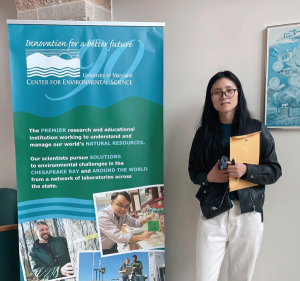
Yamin is an Environmental Science and Policy Intern at the Global Nitrogen Innovation Center for Clean Energy and the Environment (NICCEE), under the supervision of Dr. Xin Zhang and Dr. Dong Liang. She collaborates with the team to synthesize existing nitrogen budget data, aiming to provide an optimal estimate and uncertainty range for the N budget. Her main tasks include managing, processing, analyzing, and visualizing nitrogen budget data. In her spare time, Yamin enjoys building Lego, playing board games, and hiking with her family. She also has a passion for running.
Recent Happenings
AL in the News
Emily Cohen was called upon to comment on new UN migration research by the PBS NewsHour and a new fashion-climate-lifestyle publication called Atmos.
Emily and Claire Nemes are also working with Dr. Mary Stapleton of the Towson University Center for STEM Excellence to offer a summer workshop experience for Maryland educators, titled “Science in Sync: Professional Learning Experience for Maryland Teachers.” Learn more about the program here. We encourage you to share it with any Maryland science educators you may know.
Earlier this month, AL was featured on the Allegany County Economic and Community Development Blog as the epicenter of environmental science in Allegany County. Click to read the article.
The nomination window for for the Richard H. Johnson Environmental Education Award is now open. Recipients of the award receive a monetary prize to advance their environmental education efforts. Visit the AL website to see how to nominate someone.
Spring Break
Spring Break begins on Monday, March 18th. The administrative office will be closed on Monday and Tuesday. There will be no classes Monday through Friday, March 22nd.
Building Network Upgrades
The project to upgrade the building’s wireless and wired networks continue to progress. On Monday, March 18th, there will be planned network downtime for the day in the following areas:
First Floor Offices (102-105)
“IVN” Classroom (109)
Administration Wing (209/210)
Second Floor Offices by the Administration Wing (201-205)
Administration Updates & Reminders
The Appalachian Laboratory is a secure facility with key fob entry/restricted access. Some folks may wonder why our building isn’t fully accessible to the public like more typical university buildings. Key fob entry was implemented at AL to ensure greater safety and security for our lab community, but key fob access only protects everyone when we observe appropriate protocols.
Please remember to never allow anyone to tailgate or piggyback behind you through the entryways. Also, remember that just because you recognize someone, it doesn’t necessarily mean that they still have approved access to the facility. We all have an ingrained behavior to hold the door open for others, but you should never do that at a secure facility (not necessarily just at AL). You might wonder what you should say if ever found in this situation and you can say, “Sorry, I can’t let you in. You will need to use the buzzer”.
It’s not rude. It’s security.
Spotlight on Safety - SDS Online
From: Katie Kline
As mentioned in the March Town Hall, the address to access our online repository of Safety Data Sheets (SDS) has changed.
When you arrive on this page, you will be prompted for three pieces of information: the domain, username, and password:
Domain: umces
Username: ALViewer
Password: 301Braddock!
Once you login, you will be taken to the dashboard. From there, select the Safety menu option on the left side:
Then select Chemical Management:
From there, you will be taken to AL’s eBinder where you can search by chemical name or part number, see stock locations and quantities, and view or download the safety data sheet.
If you ever have any difficulty navigation the online system, please note that hard copies of SDS can be found in individual labs, as well as in the lobby vestibule. I am also happy to help if you have any trouble.
I will be updating this login information in the SDS binders found in labs and in the lobby vestibule. I will also update the Emergency Guides located in laboratories and common areas of the building. If you have an Emergency Guide in your office and would like an update, please let me know.
Resource Review - Field Safety
Are you starting to plan for your field season? In this issue, we would like to make you aware of some resources available to the AL community to help promote safety in the field:
Online Field Safety Training
We have developed an online field safety training module to help educate members of our lab community on planning and implementation of safer fieldwork experiences. It’s not mandatory, but is strongly encouraged for anyone planning, leading, or participating in fieldwork. Visit this link or click the image below to get started.
SpotX Two-Way GPS Communication Device Loan Program
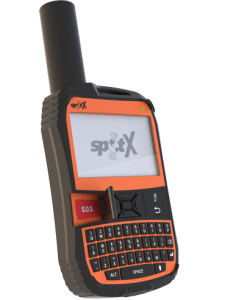
The lab has two SpotX two-way GPS communication devices available for researchers to borrow to help ensure your safety in situations where cell service might not be reliable. Click here to reserve a unit. Visit this page to see availability and to learn more about how the Spots work.
High Visibility Safety Vests
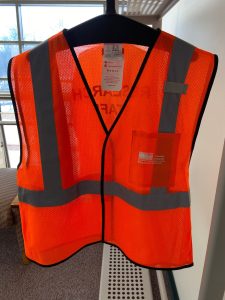
Also available to help keep you safe in the field are lightweight, UMCES-branded high visibility vests. Not only do they help keep you visible, but they also display your affiliation with UMCES, which can be helpful when encountering members of the public while in the field. Contact Katie Kline for more information.
Business Cards
Sometimes having a means to identify yourself to landowners and members of the public while performing field work can be helpful, but you might not need a box of 500 of them. Carrying business cards can be a useful safety measure when someone questions your purpose for being out in the field. Some members of the AL community could be more vulnerable in these types of situations. If you need a set for field work or for any other professional needs, please contact Katie Kline.
Recent Publications
Jeff W. Atkins, Jennifer Costanza, Kyla M. Dahlin, Matthew P. Dannenberg, Andrew J. Elmore, Matthew C. Fitzpatrick, Christopher R. Hakkenberg, Brady S. Hardiman, Aaron Kamoske, Elizabeth A. LaRue, Carlos Alberto Silva, Atticus E.L. Stovall, Elske K. Tielens. 2023. Scale dependency of lidar-derived forest structural diversity. Methods in Ecology and Evolution 14:708-723, doi:10.1111/2041-210X.14040.
Susanne Lachmuth, Thibaut Capblancq, Anoob Prakash, Stephen R. Keller, Matthew C. Fitzpatrick. 2023. Novel genomic offset metrics integrate local adaptation into habitat suitability forecasts and inform assisted migration. Ecological Monographs 94(1), doi:10.1002/ecm.1593.
Stephanie M. Siemek, Oleg Kucher, and Keith N. Eshleman. 2023. Costs of Reducing Nutrients from Riparian Buffers in Western Maryland. Journal of Agricultural and Applied Economics, 55:399-413, doi:10.1017/aae.2023.24.
Mark Your Calendars
Spring Break: UMCES will be closed on 3/18 and 3/19/24. There will be no classes from 3/18 through 3/22/24. Be sure to make advance arrangements if you expect to have administrative needs for 3/18 or 3/19.
MEES Colloquium – March 22nd
STEM Like a Girl – March 23, 2024 from 10 AM to 3 PM at Rocky Gap State Park
UMD DEI Pronouns 101 Training sponsored by the AL DEI committee will be held virtually on March 27th at 10 AM
Mandatory Workforce Civility Training – Room 109 on 4/9/24 from 9 AM to Noon – This is in person and mandatory. If you are unable to attend, please notify your supervisor immediately.
Campus Visit from new UMCES President, Dr. Fernando Miralles-Wilhelm on April 12th. There will be an all hands meeting/lunch with him that day. More details will be provided later on group meetings.
FSU Undergraduate Research Symposium, May 3rd from 11 AM to 2 PM
AL Inspiration Award – May 15th
UMCES Convocation/Commencement at IMET – May 30th-31st
Richard Johnson Environmental Education Award – August 29th
Do you have an announcement or update you’d like to include in a future newsletter?
AL’s monthly newsletter is issued during the second week of the month. Please submit any announcements and updates to Katie Kline or Heather Johnson before the close of business on the first Friday of each month to ensure that your content can be included in that month’s newsletter.