In this section, we’ll take a moment to make you aware of the key components of OSHA’s Hazardous Communication Standard (29 CFR 1910.1200):

Hazard Classification
Chemical manufacturers and importers must evaluate chemicals to classify their physical and health hazards. We don’t make products, so don’t have to perform these evaluations ourselves. Just be aware that manufacturers and importers need to do this.

Labels
Containers must have labels with:
- Product identifier
- Signal word (“Danger” or “Warning”)
- Hazard statements
- Pictograms
- Precautionary statements
- Supplier information
End users should never remove or deface container labels.

Safety Data Sheets (SDS)
- Chemical manufacturers, importers, and distributors must provide SDSs for each hazardous chemical.
- SDSs follow a 16-section format with details on hazards, handling, storage, and emergency measures.
- SDS must be accessible to employees.

Employee Training and Information
Workers must be trained on:
- Hazardous chemicals in their workplace
- How to read labels and SDSs
- Safe handling and protective measures
- Emergency procedures

Written Hazard Communication Program
Employers must develop and maintain a written program that includes:
- Chemical inventory list
- Labeling procedures
- SDS management
- Training process
These five components ensure that employees know about chemical hazards and how to work safely.
GHS Labels
Chemical labels have been developed to help you quickly determine hazards so that you can adequately protect yourself. Watch this brief explainer video about recognizing and understanding GHS chemical warning labels.
GHS labels have been around for about ten years now, but there’s still a chance that you could encounter materials here at AL that use older labeling systems. Let’s review the most common systems so that you know how to recognize potential hazards.
NFPA Labels
NFPA stands for the National Fire Protection Association. These labels are designed primarily for firefighters so that they can see at a glance if a chemical is flammable, toxic, or likely to explode. They use a color-coded diamond to quickly show the hazards of a chemical. The diamond is split into four sections, each with a color and a number. The numbers range from 0 to 4 with higher numbers assigned to greater hazards and lower number assigned to lesser hazards:
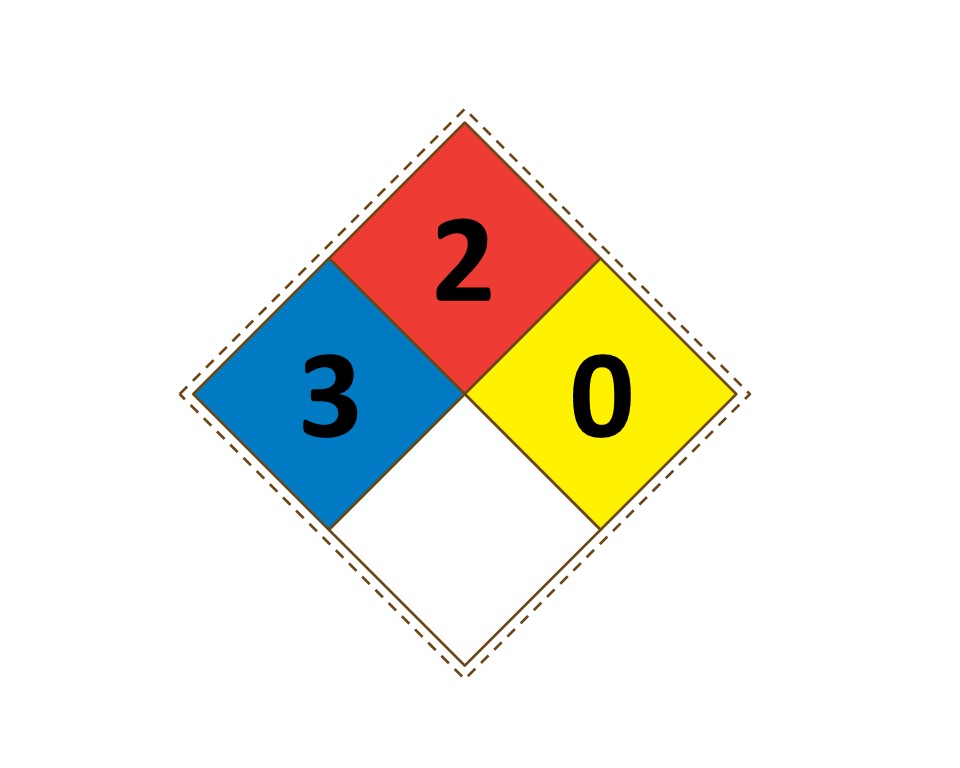
Blue = Health Hazard
- 4 = Deadly
- 3 = Extreme Danger
- 2 = Hazardous
- 1 = Slightly Hazardous
- 0 = Normal Material
Red = Fire Hazard
Flash Points
- 4 = Below 73°F
- 3 = Below 100°F
- 2 = Above 100°F not exceeding 200°F
- 1 = Above 200°F
- 0 = Will not burn
White= Specific Hazard
- ACID = Acid
- ALK = Alkali
- COR = Corrosive
- OXY = Oxidizer
- ☢ = Radioactive
W= Use No Water
Yellow = Reactivity Hazard
- 4 = May detonate
- 3 = Shock and heat may detonate
- 2 = Violent chemical change
- 1 = Unstable if heated
- 0 = Stable
HMIS Labels
The HMIS chemical labeling system stands for Hazardous Materials Identification System. This system is designed to give workers quick, easy-to-read safety information about chemicals. It uses a color-coded bar system with numbers and letters to display the hazards. Like with the NFPA diamond, the blue section represents health hazards with 0 representing no risk to 4 representing the most severe potential hazard. The red section represents flammability to show how easily the chemical can catch fire. The yellow or orange bar covers physical hazards, like explosions or reactivity. It used to be yellow for reactivity, but now it’s often orange for physical hazards, to better match GHS updates. Finally, there’s a white section for personal protective equipment (PPE), showing symbols or letters to tell you what safety gear to wear, like gloves, goggles, or a respirator:
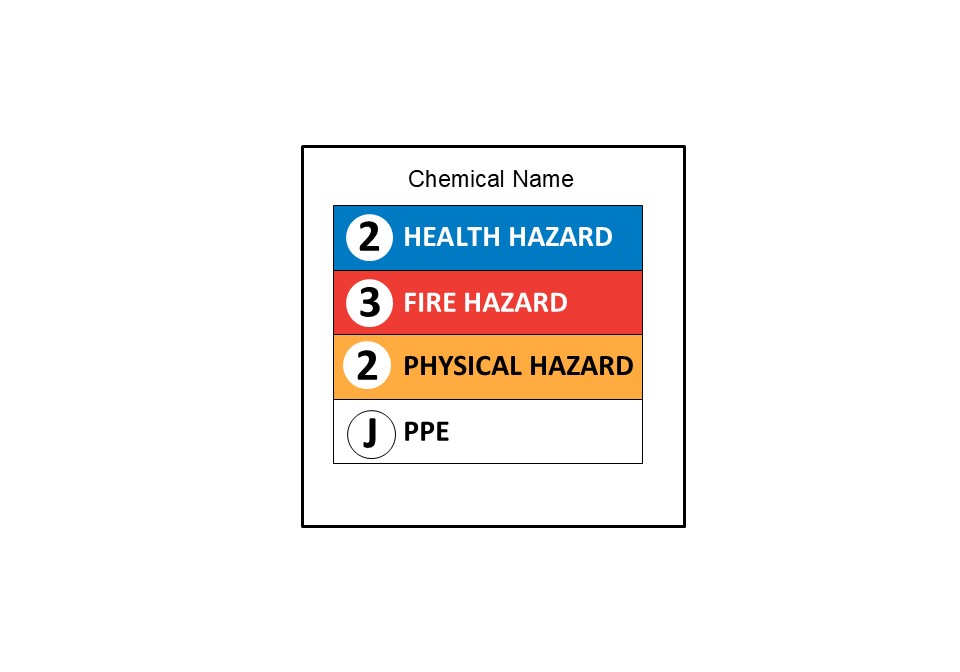
Blue = Health Hazard
- 4 = Severe Hazard
- 3 = Serious Hazard
- 2 = Moderate Hazard
- 1 = Slight Hazard
- 0 = Minimal Hazard
Red = Fire Hazard
Flash Points
- 4 = Below 73°F
- 3 = Below 100°F
- 2 = Above 100°F not exceeding 200°F
- 1 = Above 200°F
- 0 = Will not burn
White= PPE
Use the symbols or letter to select the most appropriate personal protective equipment (PPE) to protect you from the hazard.
- X. ask supervisor or safety specialist for handling instructions, or refer to the MSDS sheet for specific directions
- K. airline hood or mask, gloves, full suit and boots
- J. splash goggles, gloves, apron and a dust/vapor respirator
- I. safety glasses, gloves and a dust/vapor respirator
- H. splash goggles, gloves, apron and a vapor respirator
- G. safety glasses, a vapor respirator
- F. safety glasses, gloves, apron and a dust respirator
- E. safety glasses, gloves and a dust respirator
- D. face shield, gloves and an apron
- C. safety glasses, gloves and an apron
- B. safety glasses and gloves
- A. safety glasses
Yellow = Reactivity Hazard
- 4 = Severe Hazard
- 3 = Serious Hazard
- 2 = Moderate Hazard
- 1 = Slight Hazard
- 0 = Minimal Hazard
Labels are a key component of the OSHA HazCom standard. It’s important to be able to recognize and understand warning labels and symbols of materials you might encounter in the workplace. Next, we’ll learn about another important part of the HazCom Standard, Safety Data Sheets.